Wheel Alignment in Conyers, GA: Suspension Geometry Done Right
Authority-driven wheel alignment in Conyers, GA starts with accurate diagnostics
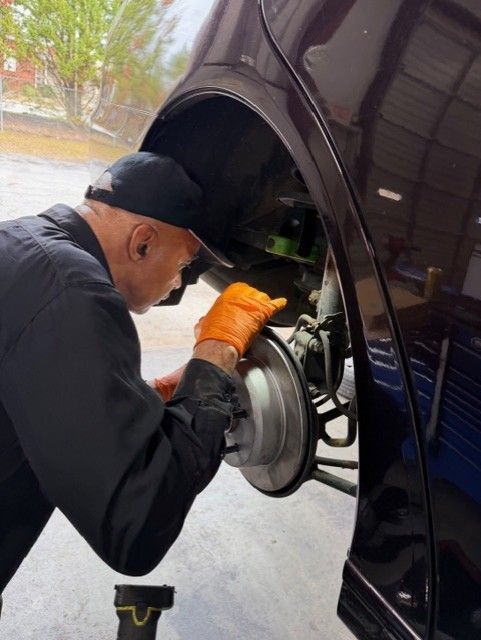
Most drivers searching for wheel alignment in Conyers, GA are noticing something isn’t right. The steering wheel may sit crooked, the vehicle may drift on I-20, or the tires may begin wearing unevenly sooner than expected. At AFR Auto Repair, 1221 Royal Dr SW, Conyers, GA 30094, suspension and steering concerns have been diagnosed continuously since May 1, 1998. Owner Jeremy Hunt built the shop around a diagnostic-first philosophy rather than quick angle adjustments. The shop’s experience is rooted in the training and background of the team at AFR Auto Repair.
In over two decades of servicing vehicles in Rockdale County, one pattern remains consistent: repeated alignments rarely solve a problem if worn suspension components are left uncorrected. Proper diagnosis always comes first.
Conyers driving conditions demand that level of precision. Stop-and-go traffic near I-20, heavy Georgia rainstorms that carve potholes into red clay soil, ongoing construction zones, and uneven pavement throughout Rockdale County all place stress on suspension geometry. These conditions influence camber, caster, and toe more than most drivers realize.
If your car is pulling left in Conyers or your steering wheel feels off center, the first step is identifying why before making adjustments.
Suspension geometry and wheel alignment fundamentals in Conyers, GA
A proper wheel alignment near me in Conyers GA search should lead to a shop that understands suspension geometry, not just alignment readings on a screen. Understanding what is included in professional wheel alignment services in Conyers, GA helps clarify the difference between quick adjustments and full-system evaluation.
Three primary angles define steering stability:
- Camber – inward or outward tilt of the tire
- Caster – forward or rearward tilt of the steering pivot
- Toe – inward or outward direction tires point relative to each other
These angles interact. Changing toe without understanding cross-camber or cross-caster compensation can create a new pull condition instead of correcting the original one.
Cross-caster and cross-camber correction
Cross-caster compensation is frequently required when correcting a vehicle drifting on the highway.
- On 2012 to 2019 Ford F-150 models, front-end component wear often reduces positive caster on one side, creating directional instability at highway speeds.
- On 2013 to 2020 Honda Accords, camber sensitivity means even minor deviations can produce noticeable steering drift.
Cross-camber imbalance can cause a pull toward the more negative camber side. If seized cam bolts prevent proper adjustment, repeated alignments fail because the suspension geometry physically cannot be corrected.
Thrust angle and rear suspension influence
Rear suspension geometry directly influences front steering correction. On 2015 to 2021 Toyota Camrys, rear toe misalignment creates thrust angle deviation that forces the steering wheel to compensate. Drivers experience this as a steering wheel off center, even if the front angles appear correct.
On 2014 to 2018 Chevrolet Silverado trucks, front-end component fatigue combined with rear suspension shift often requires full-system alignment rather than front-only correction. In these cases, inspecting the entire steering and suspension system is essential before resetting angles.
An alignment is not complete until chassis components such as control arms, bushings, tie rods, ball joints, struts, and mounting points are verified to support stable geometry.
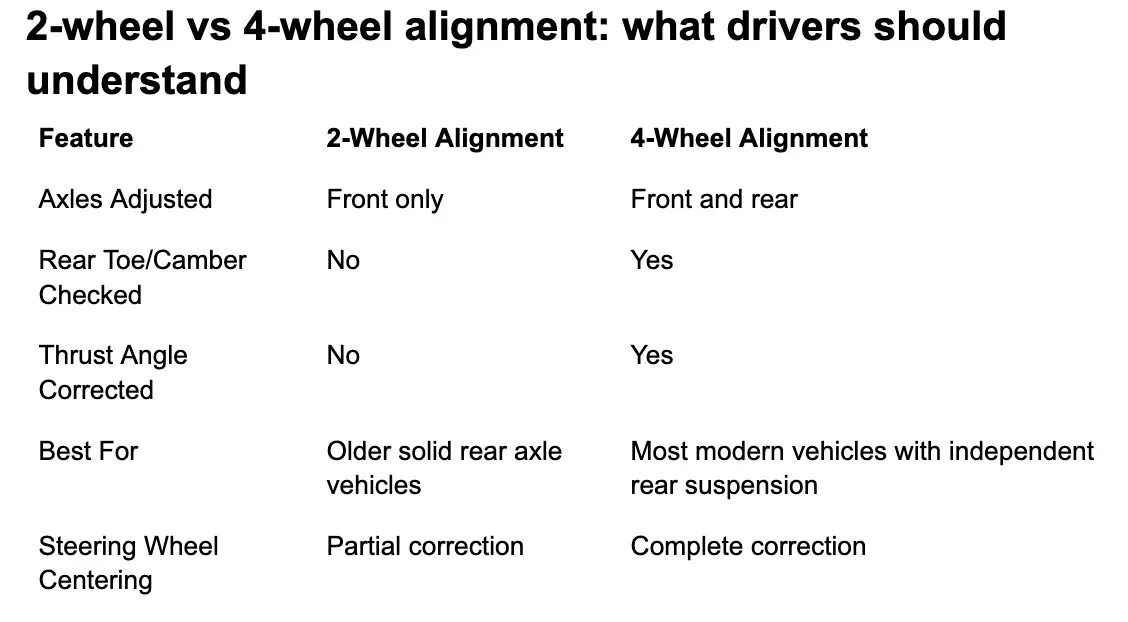
Understanding the structural difference between these procedures helps prevent temporary fixes and promotes long-term steering stability.
Many drivers are unsure whether their vehicle needs a two-wheel or four-wheel alignment. The answer depends on suspension design and vehicle age.
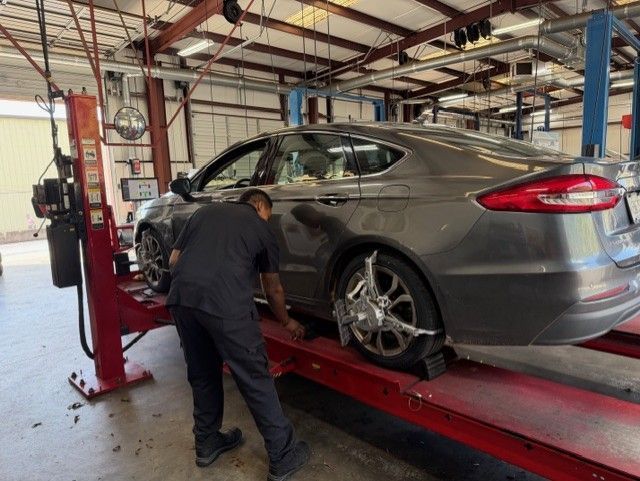
Most modern vehicles use independent rear suspension. Rear camber and toe are adjustable and directly influence thrust angle. In these cases, a four-wheel alignment is required to ensure the vehicle tracks straight. A front-only adjustment may temporarily center the steering wheel but will not correct rear thrust deviation.
Older vehicles with solid rear axles may only require front alignment adjustments, but rear axle positioning must still be inspected for shift or damage. Proper evaluation determines which procedure is appropriate.
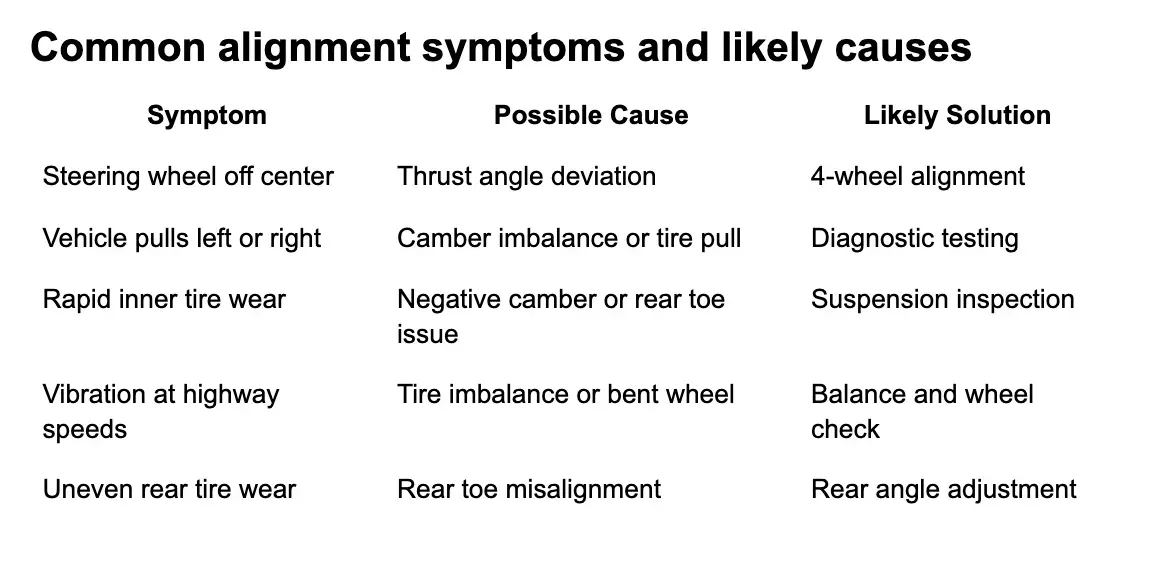
Understanding symptom patterns prevents unnecessary repairs and ensures corrective action targets the true source.
Professional suspension diagnostics isolate the real cause of steering pull
A vehicle drifting on the highway does not automatically mean an alignment is needed.
A Conyers driver recently noticed their vehicle drifted to the right each time they accelerated onto I-20. The steering wheel sat slightly off center, and they assumed it simply needed an alignment. Cross-rotation testing showed no change in pull direction, ruling out tire construction issues. Further inspection revealed a worn lower control arm bushing allowing camber to shift under load.
Once the bushing was replaced and alignment corrected, the vehicle tracked straight again. If the alignment had been adjusted without addressing the worn component, the pull would have returned quickly. This illustrates why verifying mechanical integrity matters before adjusting angles.
Tire pull vs geometry pull
Cross-rotation testing helps determine whether a car pulling left in Conyers is caused by tire construction variation, uneven tread depth, or true alignment geometry imbalance.
If the pull changes direction after rotation, it is likely tire-related. If it remains consistent, geometry becomes the primary suspect.
Alignment does not correct every steering concern. Vibration is more commonly related to tire balance or worn suspension components. In some cases, braking-related pull may require professional brake repair and service in Conyers, GA rather than alignment adjustment.
Component play evaluation
Technicians differentiate vertical ball joint play, lateral tie rod movement, wheel bearing looseness affecting alignment readings, and steering rack preload irregularities.
A worn wheel bearing can alter camber under load, skewing readings during measurement. Subframe shift measurement is critical after pothole impact. Even minor subframe movement can change suspension geometry enough to create a crooked steering wheel complaint.
Not every drift requires immediate adjustment. If tread wear remains even and the steering change occurs gradually, monitoring briefly before altering angles may be reasonable. Diagnosis should guide the decision.
When alignment is not enough
There are situations where proper alignment cannot be achieved without component replacement.
Bent control arms, damaged steering knuckles, worn ball joints, collapsed bushings, or seized cam bolts can physically prevent angles from being corrected. Attempting adjustment alone in these cases will result in readings that do not hold once the vehicle is driven.
Ride height plays a significant role. Sagging springs or worn struts alter suspension geometry at rest. Until ride height is restored, alignment settings may not remain stable.
Modified vehicles and ride height changes
Lifted trucks, lowered vehicles, and aftermarket suspension modifications require additional consideration.
Lift kits often reduce positive caster, which can lead to wandering or reduced steering return. Lowered vehicles may experience excessive negative camber, increasing inner tire wear. In some cases, aftermarket camber kits or adjustable control arms are required to achieve proper specifications.
Alignment specifications must match the vehicle’s actual configuration.
Tire wear patterns and what they reveal
Different alignment and suspension issues create distinct tire wear patterns. Recognizing these patterns helps drivers understand what may be happening before inspection.
- Inner edge wear often indicates excessive negative camber or rear toe misalignment.
- Feathering across tread blocks typically points to incorrect toe settings.
- Cupping or scalloping is commonly associated with worn struts or shocks rather than alignment angles alone.
- One-sided shoulder wear may indicate camber imbalance or bent components.
The National Highway Traffic Safety Administration outlines how tread condition affects handling and braking performance in its overview of tire safety and maintenance. Monitoring tread condition between rotations can prevent expensive tire replacement.
Alignment and advanced driver assistance systems
Many modern vehicles rely on steering angle sensors and advanced driver assistance systems such as lane departure warning and stability control.
After alignment, steering angle sensor recalibration may be required so electronic systems interpret steering position accurately.
Without proper calibration, warning lights or inconsistent lane assist behavior may occur. Industry technical publications from organizations such as SAE International explain how electronic steering systems rely on accurate chassis geometry inputs for proper function.
Mechanical alignment and electronic calibration work together to maintain safe vehicle control.
What drivers in Conyers often ask about cost and timing
Alignment pricing varies depending on vehicle type and whether component replacement is required. In the Conyers area, a standard four-wheel alignment typically ranges between $90 and $140, depending on vehicle size and suspension complexity. A straightforward four-wheel alignment typically takes less than one hour. If worn suspension components are discovered, repair time depends on part availability and component accessibility.
Attempting repeated low-cost adjustments without addressing worn parts often increases long-term expense through accelerated tire wear.
Georgia environmental factors accelerate suspension repair needs in Conyers, GA
The Conyers environment plays a measurable role in suspension wear.
Georgia heat accelerates rubber bushing breakdown. Heavy rainfall and red clay soil contribute to rapid pothole formation. Even a moderate pothole impact can slightly shift a subframe without obvious visual damage, leading to gradual and often unnoticed uneven tire wear.
Fleet vehicles operating daily along I-20 experience increased control arm stress and ball joint wear. Businesses managing multiple vehicles often rely on structured fleet service and repair in Conyers, GA to reduce long-term operating costs.
Drivers commuting daily at highway speeds may benefit from more frequent inspections than vehicles driven locally.
Digital vehicle inspections support accurate wheel alignment in Conyers, GA
Alignment machine readings alone do not tell the full story. Comprehensive diagnostics are part of broader auto services in Conyers, GA that evaluate the vehicle as a system.
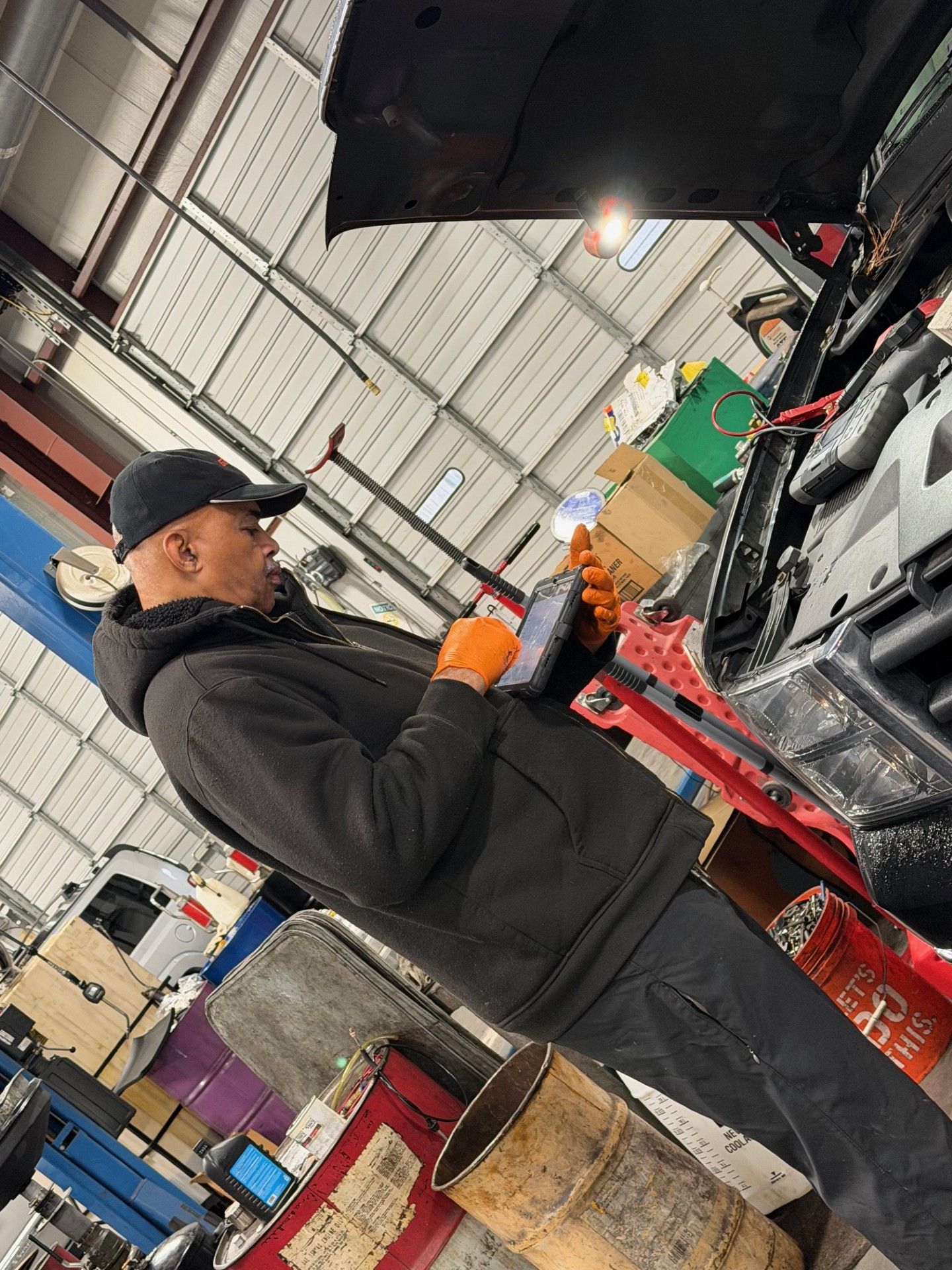
Digital Vehicle Inspections typically include photo documentation of worn bushings, tie rods, and struts, detailed technician notes explaining how each component affects geometry, and clear repair options.
Proper alignment begins with verified mechanical stability.
The financial impact of improper alignment and suspension neglect
A slight camber deviation can shorten tire life by thousands of miles, especially in stop-and-go Conyers traffic. Rear toe imbalance accelerates inside edge wear that may not be visible until rotation time.
Preventive suspension repair protects tire investment, preserves braking performance, and maintains steering predictability. Correcting worn components early prevents alignment instability and repeat tire wear, while delaying necessary suspension repairs often results in premature tire replacement and higher long-term costs.
Frequently asked questions about wheel alignment in Conyers, GA
How often should I get a wheel alignment?
Annual inspections are recommended for most drivers. High-mileage commuters or vehicles that encounter frequent potholes may require more frequent evaluation.
Why does my car still pull after an alignment?
Worn components, seized hardware, or uncorrected thrust angle may prevent settings from holding under load.
Can alignment fix vibration?
No. Vibration is typically caused by tire imbalance, bent wheels, or worn suspension components.
Do modern vehicles require recalibration?
Many late-model vehicles require steering angle sensor recalibration after alignment to maintain stability control accuracy and prevent warning indicators.
How long does a wheel alignment last?
Under normal driving conditions, alignment settings can remain stable for 12 months or longer. However, pothole impacts, curb strikes, suspension wear, or modified ride height can shorten that interval.
How much does a wheel alignment cost in Conyers, GA?
Pricing varies by vehicle type and suspension design. Most standard four-wheel alignments fall within a predictable range, but additional repairs may affect final cost.
Is a free alignment check worth it?
A preliminary inspection can identify obvious angle deviations, but meaningful results require full suspension inspection and test driving to verify the root cause of pull or tire wear.
Can I drive with bad alignment?
Driving with misalignment may not feel dangerous immediately, but it accelerates tire wear, reduces braking efficiency, and can affect steering predictability over time. Vehicles equipped with stability control or lane assist systems may also require steering angle sensor recalibration to ensure electronic systems interpret steering input accurately after suspension adjustments.
Trusted wheel alignment and suspension repair in Conyers, GA since 1998
Since May 1, 1998, AFR Auto Repair has served Conyers as a locally established auto repair shop providing suspension repair, brake service, alignment correction, and fleet maintenance with a diagnostic-first approach.
As one Rockdale County customer recently shared, "After two failed alignments elsewhere, AFR found the worn control arm and fixed the issue the first time." Consistent diagnostic transparency builds long-term trust.
Located at 1221 Royal Dr SW, Conyers, GA 30094, near I-20, qualifying repairs are backed by a 2-year / 24,000-mile warranty. Loaner vehicles and shuttle service help minimize disruption while repairs are completed.
Drivers can stay updated through the shop’s community posts and service updates on Facebook or call (770) 685-7849 to schedule an inspection.
If your vehicle is drifting, your steering wheel is off center, or you are noticing uneven tire wear, correcting suspension geometry helps protect steering stability, tire investment, and long-term safety.